
Sijia Liu
PhD student in Computer Science at Princeton University
RSI · Discovery · Agents · Alignment
Hello! I am a third-year CS PhD student at Princeton University, advised by Prof. Karthik Narasimhan at Princeton Language and Intelligence 🐯.
My research primarily focuses on LLM post-training and training and evaluating long-horizon agents. In summer 2026, I interned at the Allen Institute for AI (Ai2) working on AutoDiscovery. Previously, I received dual bachelor’s degrees from Peking University and a master’s degree from Carnegie Mellon University.
👩🎓 I’m currently looking for industry internships in the SF / Bay Area!
News
- I joined Ai2 as a research intern (PhD) in Seattle, hosted by Dr. Bodhisattwa Majumder, Dr. Ashish Sabharwal and Dr. Peter Clark.
- We introduce ContextRL, a context-aware RL objective that rewards models for selecting the context that supports an answer, improving long-horizon agentic and multimodal reasoning by +2.2% and +1.8% over standard GRPO.
- I passed my general exam and am officially a PhD candidate! Huge thanks to my advisor and my committee: Karthik Narasimhan, Danqi Chen, and Zhuang Liu.
- Humanline has been accepted to ICLR 2026. See you in Rio!
- Received the generous Tinker teaching grant to support our undergraduate Introduction to NLP course.
- Received the Tinker research grant ($5,000) to support our research on post-training algorithms.
Selected Publications
LLM Post-Training
-
Humanline: Online Alignment as Perceptual Loss
ICLR 2026
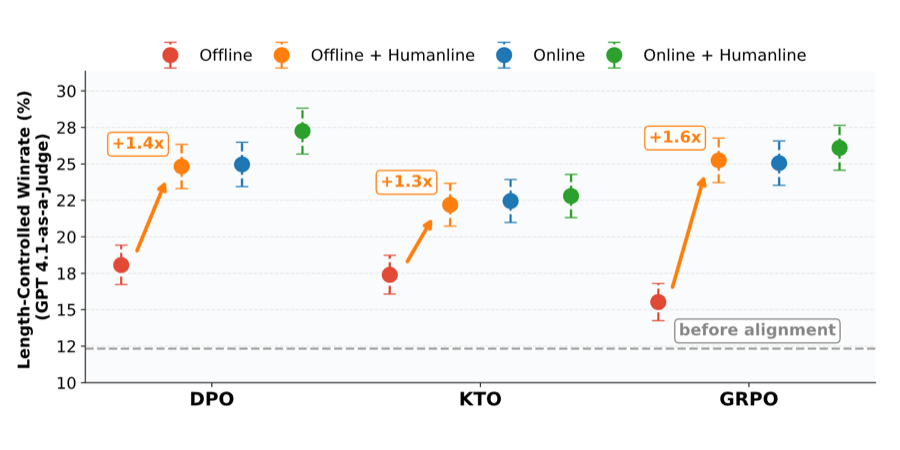
TL;DR Online alignment works because it mirrors how humans perceive probability; building that bias into DPO, KTO and GRPO lets training on offline data match online performance.
Online alignment (e.g., GRPO) is generally more performant than offline alignment (e.g., DPO) – but why? Drawing on prospect theory from behavioral economics, we propose a human-centric explanation. We prove that online on-policy sampling better approximates the human-perceived distribution of what the model can produce, and PPO/GRPO-style clipping – originally introduced to just stabilize training – recovers a perceptual bias in how humans perceive probability. In this sense, PPO/GRPO act as perceptual losses already. Our theory further suggests that the online/offline dichotomy is itself incidental to maximizing human utility, since we can achieve the same effect by selectively training on any data in a manner that mimics human perception, rather than restricting ourselves to online on-policy data. Doing so would allow us to post-train more quickly, cheaply, and flexibly without sacrificing performance. To this end, we propose a design pattern that explicitly incorporates perceptual distortions of probability into objectives like DPO/KTO/GRPO, creating humanline variants of them. Surprisingly, we find that these humanline variants, even when trained with offline off-policy data, can match the performance of their online counterparts on both verifiable and unverifiable tasks.
@article{liu2025humanline, title = {Humanline: Online Alignment as Perceptual Loss}, author = {Liu, Sijia and Muennighoff, Niklas and Ethayarajh, Kawin}, year = {2025}, eprint = {2509.24207}, archiveprefix = {arXiv}, primaryclass = {cs.AI}, } -
The Amazon Nova family of models: Technical report and model card
Amazon Technical Reports · 2024
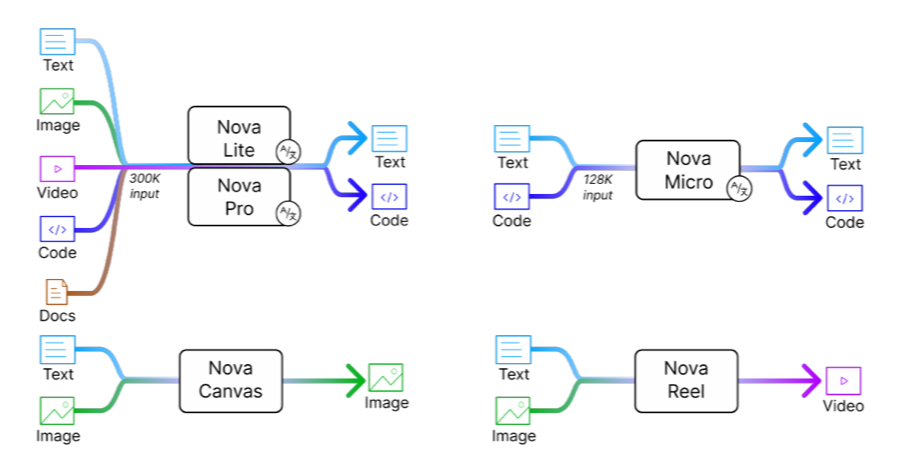
TL;DR Technical report for Amazon Nova, a family of foundation models covering multimodal understanding (Micro, Lite, Pro) and image and video generation (Canvas, Reel).
We present Amazon Nova, a new generation of state-of-the-art foundation models that deliver frontier intelligence and industry-leading price performance. Amazon Nova Pro is a highly-capable multimodal model with the best combination of accuracy, speed, and cost for a wide range of tasks. Amazon Nova Lite is a low-cost multimodal model that is lightning fast for processing images, video, documents and text. Amazon Nova Micro is a text-only model that delivers our lowest-latency responses at very low cost. Amazon Nova Canvas is an image generation model that creates professional grade images with rich customization controls. Amazon Nova Reel is a video generation model offering high-quality outputs, customization, and motion control. Our models were built responsibly and with a commitment to customer trust, security, and reliability. We report benchmarking results for core capabilities, agentic performance, long context, functional adaptation, runtime performance, and human evaluation.
@article{Intelligence2024, author = {Intelligence, Amazon Artificial General}, title = {The Amazon Nova family of models: Technical report and model card}, year = {2024}, url = {https://www.amazon.science/publications/the-amazon-nova-family-of-models-technical-report-and-model-card}, journal = {Amazon Technical Reports}, } -
LLM Self-Correction with DeCRIM: Decompose, Critique, and Refine for Enhanced Following of Instructions with Multiple Constraints
EMNLP, NeurIPS Workshop on System 2 Reasoning at Scale (Oral) · 2024
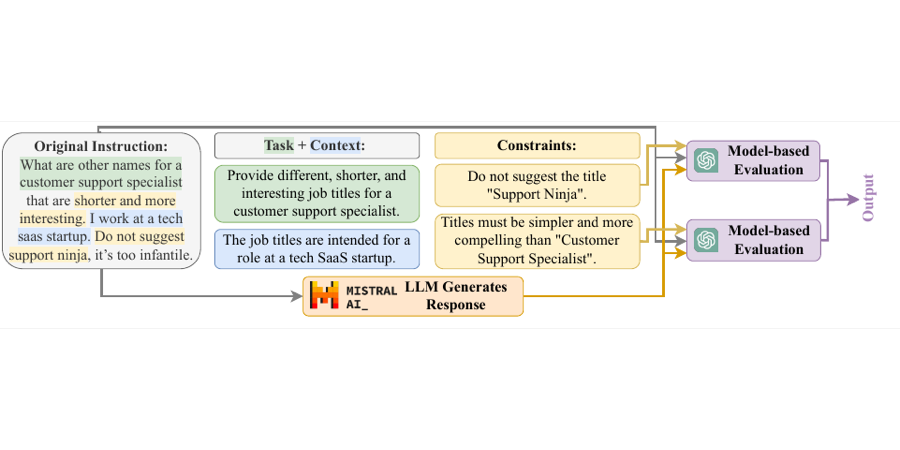
TL;DR RealInstruct, a benchmark of real multi-constraint user requests, and DeCRIM, a decompose-critique-refine pipeline that lets open-source LLMs outperform GPT-4 with strong feedback.
Instruction following is a key capability for LLMs. However, recent studies have shown that LLMs often struggle with instructions containing multiple constraints (e.g. a request to create a social media post "in a funny tone" with "no hashtag"). Despite this, most evaluations focus solely on synthetic data. To address this, we introduce RealInstruct, the first benchmark designed to evaluate LLMs’ ability to follow real-world multi-constrained instructions by leveraging queries real users asked AI assistants. We also investigate model-based evaluation as a cost-effective alternative to human annotation for this task. Our findings reveal that even the proprietary GPT-4 model fails to meet at least one constraint on over 21% of instructions, highlighting the limitations of state-of-the-art models. To address the performance gap between open-source and proprietary models, we propose the Decompose, Critique and Refine (DeCRIM) self-correction pipeline, which enhances LLMs’ ability to follow constraints. DeCRIM works by decomposing the original instruction into a list of constraints and using a Critic model to decide when and where the LLM’s response needs refinement. Our results show that DeCRIM improves Mistral’s performance by 7.3% on RealInstruct and 8.0% on IFEval even with weak feedback. Moreover, we demonstrate that with strong feedback, open-source LLMs with DeCRIM can outperform GPT-4 on both benchmarks.
@article{ferraz2024llmselfcorrectiondecrimdecompose,
  title = {LLM Self-Correction with DeCRIM: Decompose, Critique, and Refine for Enhanced Following of Instructions with Multiple Constraints},
  author = {Ferraz, Thomas Palmeira and Mehta, Kartik and Lin, Yu-Hsiang and Chang, Haw-Shiuan and Oraby, Shereen and Liu, Sijia and Subramanian, Vivek and Chung, Tagyoung and Bansal, Mohit and Peng, Nanyun},
  year = {2024},
  journal = {EMNLP, NeurIPS Workshop on System 2 Reasoning at Scale <span class="oral-tag"><b><i>(Oral)</i></b></span>},
  eprint = {2410.06458},
  archiveprefix = {arXiv},
  primaryclass = {cs.CL},
  url = {https://arxiv.org/abs/2410.06458},
}
Training and Evaluating Long-Horizon Agents
-
Context-Aware RL for Agentic and Multimodal LLMs
COLM 2026 Workshop on Efficient Reasoning (Best Paper Runner-up)
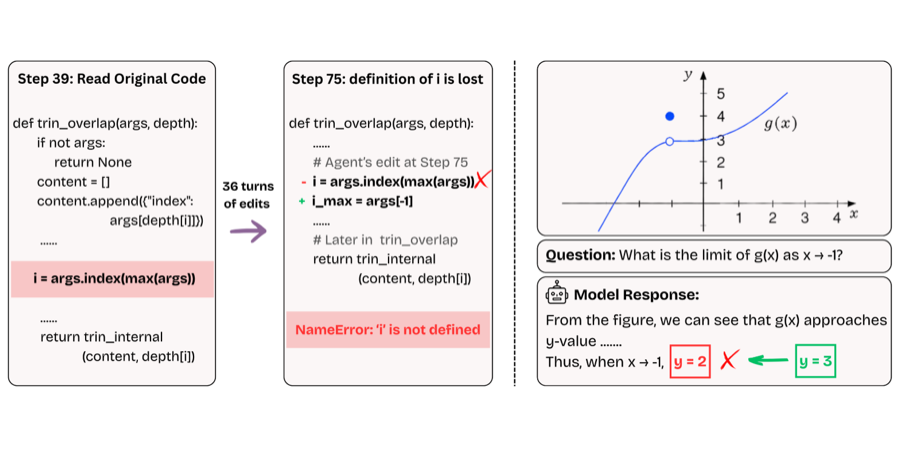
TL;DR Rewarding a model for picking which of two near-identical contexts supports an answer teaches fine-grained grounding, beating GRPO on long-horizon agent and multimodal benchmarks.
[][arXiv][]
Large language models (LLMs) often fail when answering requires identifying a small but decisive piece of evidence within a long or complex context, such as a single line in a tool trace or a subtle detail in an image. We propose ContextRL, a context-aware reinforcement learning (RL) method that improves long-horizon reasoning and multimodal performance through an indirect auxiliary objective. Instead of supervising only the final answer, ContextRL presents the model with a query, an answer, and two highly similar contexts, and rewards it for selecting the context that supports the query–answer pair, thereby encouraging fine-grained grounding. We construct contrastive context data in two domains: for coding agents, trajectories serve as contexts, yielding 1k pairs built via condition filtering; for multimodal reasoning, images serve as contexts, yielding 7K pairs built via generative editing and similarity search. ContextRL achieves average gains of +2.2% over standard GRPO on 5 long-horizon benchmarks, and +1.8% across 12 diverse visual question answering benchmarks. To disentangle the effect of the proposed objective from that of additional data, we compare against data-augmentation baselines that repurpose the same contrastive contexts as standard query–context–answer examples. These baselines provide little to no improvement, showing that the gains arise from the proposed context-selection objective rather than from the contrastive data alone.
@article{xu2026contextrl, journal = {COLM 2026 Workshop on Efficient Reasoning <span class="oral-tag"><b><i>(Best Paper Runner-up)</i></b></span>}, title = {Context-Aware RL for Agentic and Multimodal LLMs}, author = {Xu, Peiyang and Li, Bangzheng and Liu, Sijia and Narasimhan, Karthik R. and Viswanath, Pramod and Mittal, Prateek and Fu, Xingyu}, year = {2026}, eprint = {2606.17053}, archiveprefix = {arXiv}, primaryclass = {cs.CL}, } -
Towards Credible Human Evaluation of Open-Domain Dialog Systems Using Interactive Setup
AAAI (Oral), NeurIPS Workshop on Human Evaluation of Generative Models (Oral), EMNLP Workshop on Natural Language Generation, Evaluation, and Metrics (Oral) · 2023
TL;DR Compares interactive, per-turn human evaluation setups for open-domain chatbots on sensitivity and consistency, and shows how to estimate the sample size needed up front.
[][paper][pdf][slides][poster][]
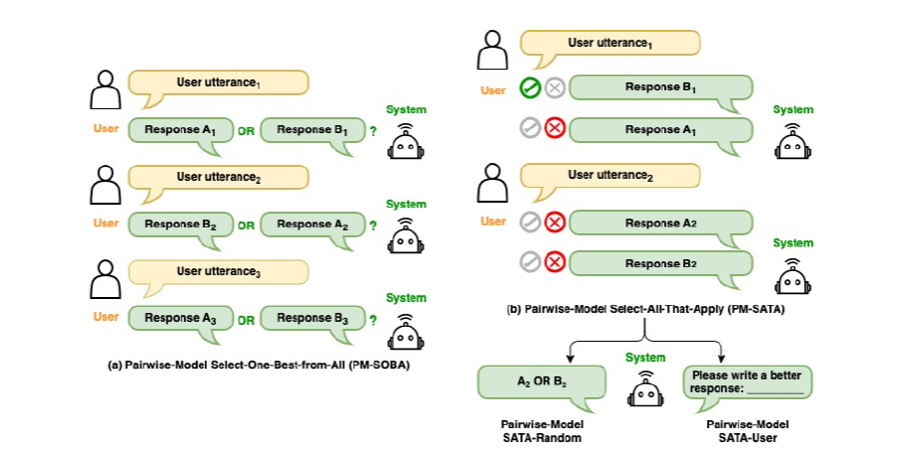
Evaluating open-domain conversation models has been an open challenge due to the open-ended nature of conversations. In addition to static evaluations, recent work has started to explore a variety of per-turn and per-dialog interactive evaluation mechanisms and provide advice on the best setup. In this work, we adopt the interactive evaluation framework and further apply to multiple models with a focus on per-turn evaluation techniques. Apart from the widely used setting where participants select the best response among different candidates at each turn, one more novel per-turn evaluation setting is adopted, where participants can select all appropriate responses with different fallback strategies to continue the conversation when no response is selected. We evaluate these settings based on sensitivity and consistency using four GPT2-based models that differ in model sizes or fine-tuning data. To better generalize to any model groups with no prior assumptions on their rankings and control evaluation costs for all setups, we also propose a methodology to estimate the required sample size given a minimum performance gap of interest before running most experiments. Our comprehensive human evaluation results shed light on how to conduct credible human evaluations of open domain dialog systems using the interactive setup, and suggest additional future directions.
@article{Liu_Lange_Hedayatnia_Papangelis_Jin_Wirth_Liu_Hakkani-Tur_2023, title = {Towards Credible Human Evaluation of Open-Domain Dialog Systems Using Interactive Setup}, number = {11}, journal = {AAAI <span class="oral-tag"><b><i>(Oral)</i></b></span>, NeurIPS Workshop on Human Evaluation of Generative Models <span class="oral-tag"><b><i>(Oral)</i></b></span>, EMNLP Workshop on Natural Language Generation, Evaluation, and Metrics <span class="oral-tag"><b><i>(Oral)</i></b></span>}, volume = {37}, url = {https://ojs.aaai.org/index.php/AAAI/article/view/26557}, doi = {10.1609/aaai.v37i11.26557}, author = {Liu, Sijia and Lange, Patrick and Hedayatnia, Behnam and Papangelis, Alexandros and Jin, Di and Wirth, Andrew and Liu, Yang and Hakkani-Tur, Dilek}, year = {2023}, month = jun, pages = {13264-13272}, } -
Improving Bot Response Contradiction Detection via Utterance Rewriting
SIGDIAL (Oral) · 2022
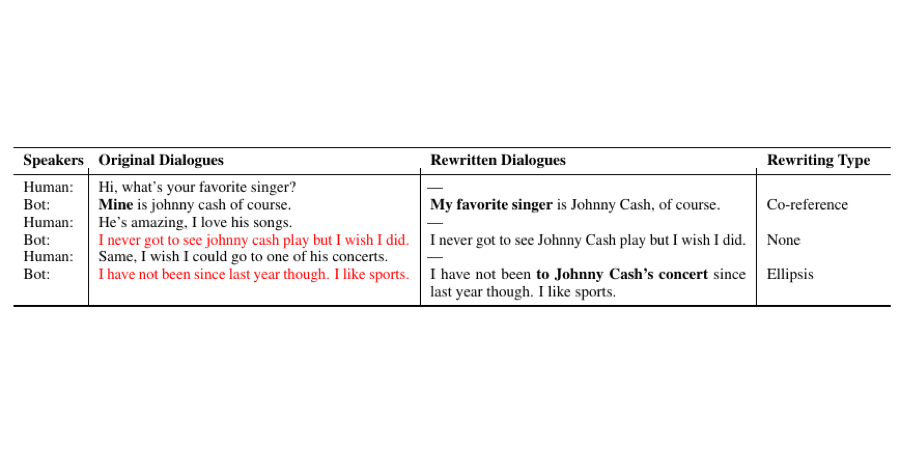
TL;DR Rewriting chatbot utterances to restore ellipsis and co-references significantly improves detection of contradictions with earlier turns.
Though chatbots based on large neural models can often produce fluent responses in open domain conversations, one salient error type is contradiction or inconsistency with the preceding conversation turns. Previous work has treated contradiction detection in bot responses as a task similar to natural language inference, e.g., detect the contradiction between a pair of bot utterances. However, utterances in conversations may contain co-references or ellipsis, and using these utterances as is may not always be sufficient for identifying contradictions. This work aims to improve the contradiction detection via rewriting all bot utterances to restore antecedents and ellipsis. We curated a new dataset for utterance rewriting and built a rewriting model on it. We empirically demonstrate that this model can produce satisfactory rewrites to make bot utterances more complete. Furthermore, using rewritten utterances improves contradiction detection performance significantly, e.g., the AUPR and joint accuracy scores (detecting contradiction along with evidence) increase by 6.5% and 4.5% (absolute increase), respectively.
@article{jin2022improving,
  title = {Improving Bot Response Contradiction Detection via Utterance Rewriting},
  author = {Jin, Di and Liu, Sijia and Liu, Yang and Hakkani-Tur, Dilek},
  year = {2022},
  month = jul,
  journal = {SIGDIAL <span class="oral-tag"><b><i>(Oral)</i></b></span>},
}
Experience
-
 Allen Institute for AI (Ai2) · Research Intern
- Research on long-horizon hypothesis generation for AutoDiscovery.
-
 Amazon AGI · Research Scientist, Post-Training Team
- Contributed to the development of Amazon Nova, state-of-the-art text and multimodal models.
- Contributed to the Alexa Prize SocialBot Grand Challenge, building ultra-long open-domain dialogue systems.
- Worked with Dr. Yang Liu and Prof. Dilek Hakkani-Tur.
Blogs
Coming soon.
Life
- Health & Sports
- I value health and enjoy sports, including snowboarding, badminton, and running. Half marathon PR 2:10:15 (Brooklyn, Apr 2025).
- Languages
- A language lover at heart. Pre-trained on Chinese and fine-tuned on English, Korean, German, and Japanese, though I might suffer from catastrophic forgetting sometimes.
- Performing Arts
- Co-founder of the STArt (Seattle Theater Art) Film Studio, and scriptwriter of Wedding Bells (2021).
- Pets
- A cat lover, with a cute beige American shorthair.